 SumaFlow Chart
 Her whole medical history. On your phone. Nowhere else.
Your family's medical records, kept on your phone. No account, no cloud.
Chart holds the documents a household already has — lab results, prescriptions, discharge notes, the letter from the specialist — reads the values off each page on the device, records consultations, and keeps medications and appointments in one place for everyone in the family. When there is an appointment, it prints one page the patient hands across the desk.
The record already exists. It's just in six places.
Almost nothing a household needs at an appointment is missing. It has all been printed, photographed or filed at some point — and then scattered. Chart's job is not to produce a record. It is to hold the one you already have, in one place, on a phone that comes with you.
-
The drawer
Discharge summaries, lab printouts, the letter from the specialist. Filed by whoever got to the post first, in an order only they can reconstruct.
-
The portals
One login for the hospital, another for the lab, a third for the clinic across town. Each holds a slice of the record. None of them holds the rest, and none of them will hand it over in a format the next one accepts.
-
The photo roll
A picture of a prescription, taken in a corridor because there was no other way to keep it. It is now four thousand photos back, between a receipt and a dog.
-
The person who remembers
One member of the family carries the allergies, the doses and the dates in their head. They are not always in the room, and they should not have to be.
-
The appointment
It opens with the same three questions every time — what are the allergies, what conditions are there, what is she taking — and the answers are at home in the drawer.
-
The move
A new phone, a new city, a new clinic, a parent moving in. The record has to travel with the family rather than stay behind with a provider.
One box, on the phone in your pocket.
Documents, the values read off them, consultations, medications and appointments, for everyone in the household — filed once, findable by anyone the household has given the key to, and printable on the way out the door. There is no account to make and nowhere for any of it to be uploaded.
Every value checked against the actual page.
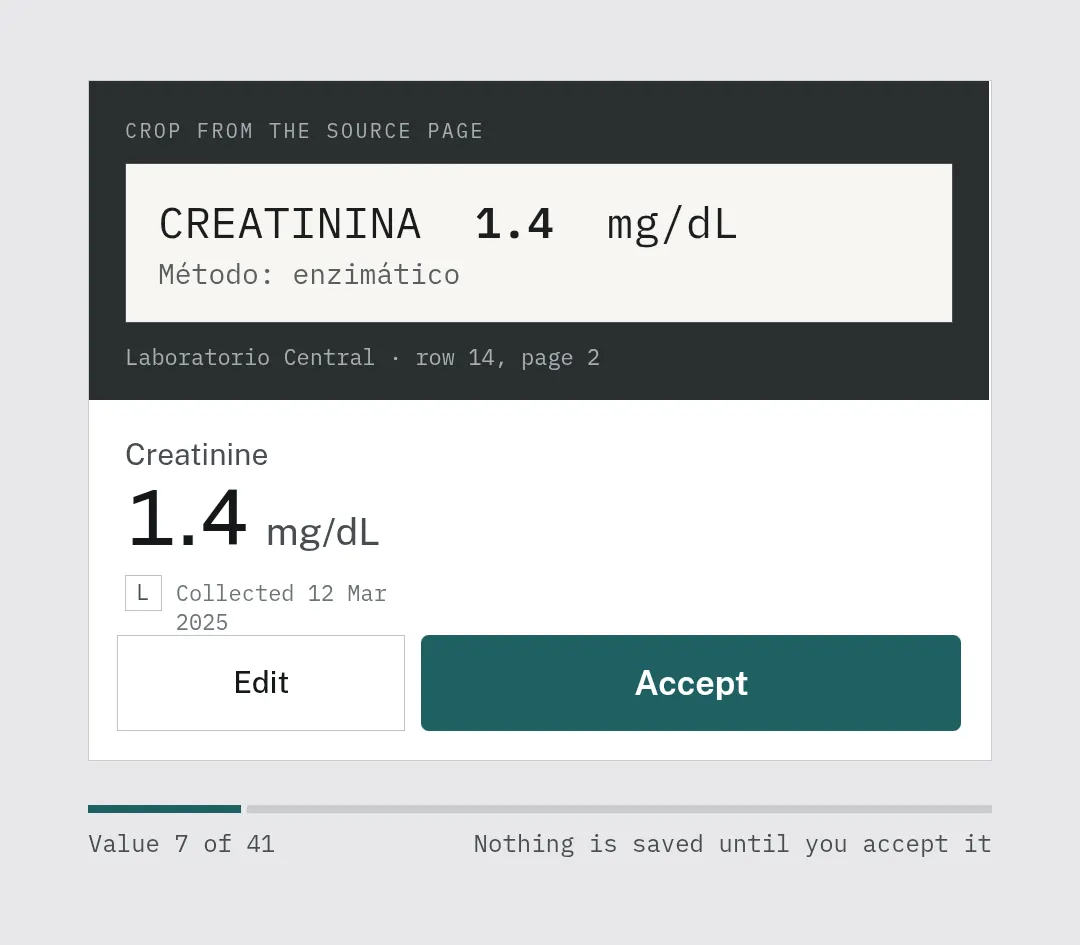
Chart reads a document on the device and proposes what it found. It files none of it. Each candidate arrives on its own card with the crop it came from above it and the parsed value below, and nothing is saved to the record until you say so.
-
The crop comes first
The region of the page the value was read from sits directly above the value itself, rendered large enough to read without pinching. Checking a figure is a glance, not a hunt back through a forty-page PDF.
-
Reading is not filing
A value that was read but not confirmed is not in the record. There is no half-saved state and no queue to tidy up later — you accept it, correct it, or skip it, and only then does it exist.
-
Every figure keeps its source
L from a laboratory document, Rx from a prescription, M entered by a household member, A from a recorded consultation. The marker travels with the value all the way onto the printed page, so anyone reading it can see where it came from.
-
The three-hundredth looks like the first
No checkmark animation, no toast, no celebration on save. Confirming carries the same weight every time, so it is given the same treatment every time — which is what makes it possible to sit down and get through a folder.
What the card shows is the document and what was read off it, side by side. It does not say whether a number is good, bad, high or low — there is no band, no target line, and no figure anywhere in the app that changes colour according to what it says, because Chart is a record and drawing that conclusion is a clinician's job.
Allergies, conditions and medications — always the first three questions.
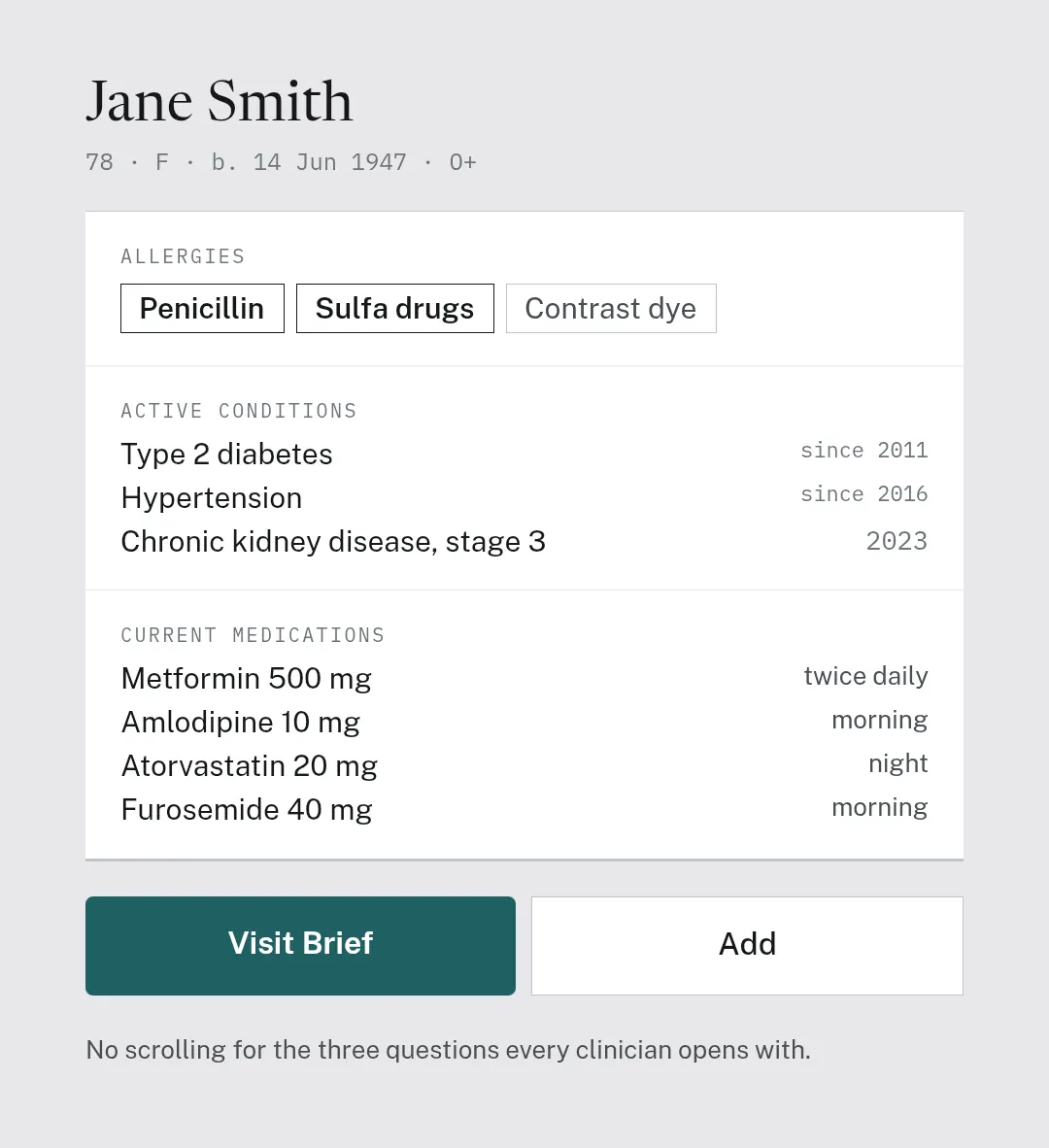
Open a member and the three things a room full of clinicians asks about first are already there: what she reacts to, what she is being treated for, and what she is taking. No tab, no scroll, no search.
The three sit in a single white slab with hairline rules between them and no gutters at all, which is what buys the density — three sections in the space a stack of cards would give to one. Allergies, conditions and four of six medications land inside 470dp, comfortably above the fold on any current Android phone, with the Visit Brief button still on screen underneath them.
Below the slab the page keeps the same rhythm at lower contrast: the next appointments, the last few things filed and what they came from, and the rest of the record — documents, values, care tasks, notes, providers, the full timeline. The eye stops at the slab because everything under it is quieter, not because anything is hidden.
- Sets in ink A recorded allergy is set at full weight and a noted one is lighter. That is the only distinction the screen draws, and it is made with type rather than colour — the palette has no red in it to reach for.
- Survives 200% Single column, wrapping rows, no fixed-height text boxes. At the largest system text size the layout reflows instead of truncating, and allergies and conditions stay above the fold with medications one short scroll below.
- Nothing is scored There is no summary line, no status, no badge and no total. The screen is a list of what the household has recorded, in the order it gets asked for.
Everything her doctors ask, on one page.
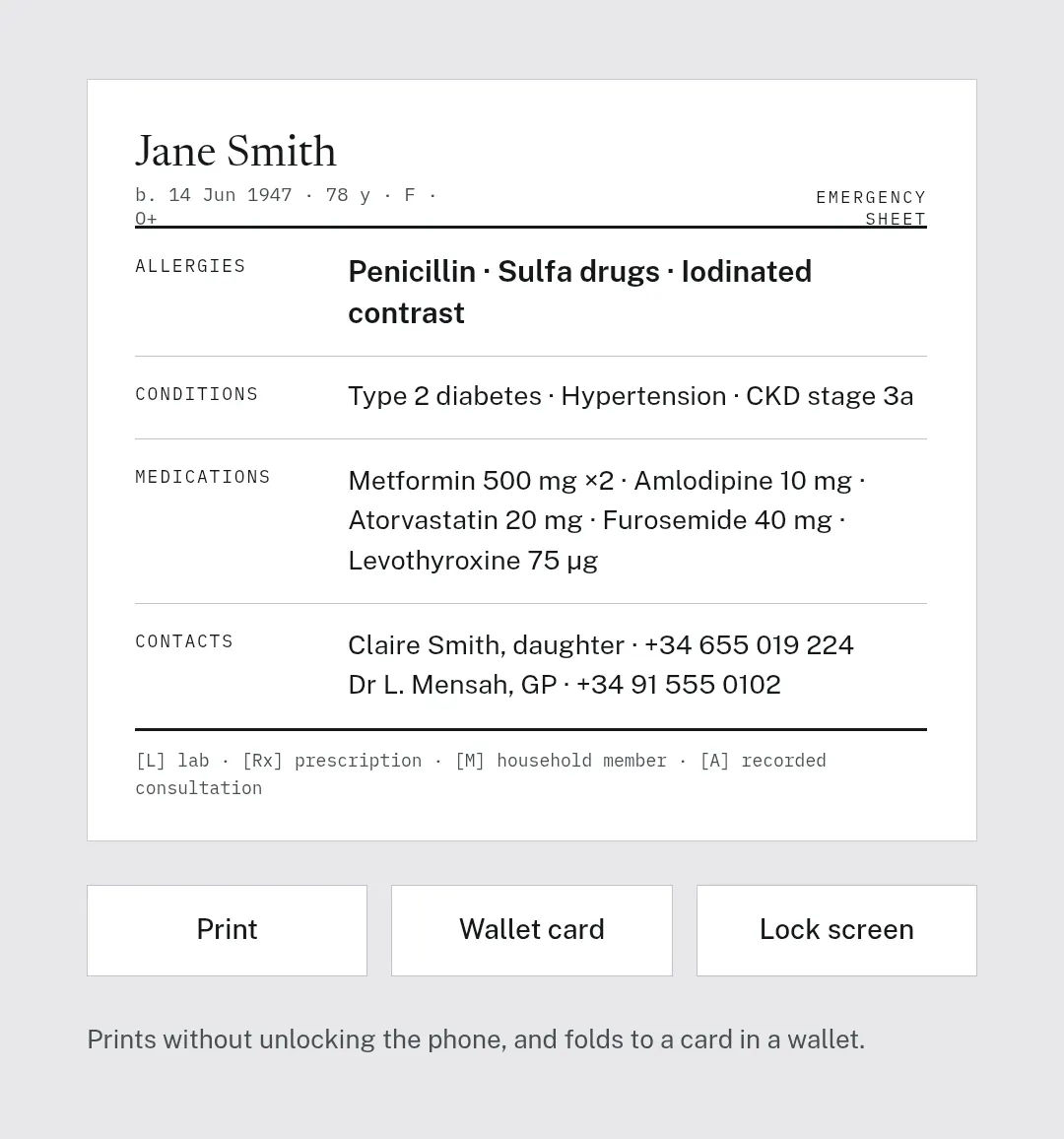
The whole app exists to produce two sheets of paper. One is prepared for an appointment and handed across the desk; the other lives in a wallet for the day nobody is in a position to answer questions.
| Drug | Dose | Schedule | Since · src |
|---|---|---|---|
| Metformin | 500 mg | Twice daily, with food | 2011 [Rx] |
| Amlodipine | 10 mg | Once daily, morning | Apr 25 [A] |
| Atorvastatin | 20 mg | Once daily, night | 2018 [Rx] |
| Furosemide | 40 mg | Once daily, morning | 2023 [Rx] |
| Levothyroxine | 75 µg | Once daily, fasting | 2016 [Rx] |
| Cholecalciferol | 1000 IU | Once daily | 2021 [M] |
| Measure | Value | Previous | Date · src |
|---|---|---|---|
| Creatinine | 1.4 mg/dL | 1.1 · Nov 24 | 14 Mar [L] |
| eGFR | 42 mL/min/1.73m² | 51 · Nov 24 | 14 Mar [L] |
| HbA1c | 7.2 % | 7.4 · Nov 24 | 14 Mar [L] |
| Potassium | 5.1 mmol/L | 4.6 · Nov 24 | 14 Mar [L] |
| Blood pressure | 178/104 mmHg | 152/88 · 28 Mar | 2 Apr [M] |
| Weight | 68.4 kg | 70.1 · 28 Feb | 2 Apr [M] |
- Ask about the change in creatinine and eGFR since November.
- Ask whether furosemide and the potassium result should be reviewed together.
- Ask what to do about the dizziness in the mornings since the amlodipine change.
- Ask whether the knee injection can be scheduled before the trip in June.
The Visit Brief · print or PDF · fits A4 and US Letter
Prepared for the appointment
Identity, allergies, conditions, current medications, the most recent value per measure, the last few encounters, and the questions the household actually wants to ask — on one page, set inside a live area that fits both A4 and US Letter without reflowing, so one layout serves both. The footer says who produced the page and when.
Each observation prints the previous figure beside the current one with its date, because that is what gets asked for. It prints as a bare prior number: no arrow, no difference, no band, no colour. Values are reproduced as recorded — the page is a record, not a clinical assessment, and it says so in its own footer.
Ready before it is needed
The same four things, shorter: allergies, conditions, medications, and who to call. It prints without unlocking the phone, it can sit on the lock screen, and it folds down to an 85 × 54 mm card — a bank card's footprint — that goes in a wallet next to the ones already there.
Both sheets are produced from what the household confirmed, and both carry the source marker beside every figure, so the person reading it can tell a laboratory printout from something a family member typed in.
No sign-up. No cloud. Nothing leaves your phone.
A household medical record is about the most sensitive folder a family owns. The way to keep it safe is not a policy about what we promise to do with it — it is not receiving it in the first place.
-
There is no account
No email, no password, no verification, no "continue with". The app opens and you start filing. There is nothing to sign up for, nothing to be locked out of and nothing to forget.
-
There is no server
Documents, recordings and values live on the phone. Nothing is transmitted, because there is nowhere for it to be transmitted to — no backend of ours holds a copy of a household, and none ever will.
-
A household is joined by a key
Twenty-four words, exchanged device to device. The household file can travel by email or chat and on its own it opens nothing, wherever it ends up; the key is read from the other phone in the room and never touches a network.
-
The consultation stays on the phone
A visit is recorded and read on the device. The audio is never uploaded, never sent for transcription and never leaves the handset — which is the only version of that promise worth making in a consulting room.
-
Nothing leaves unless you send it
Printing, sharing and exporting are deliberate acts, one file at a time, and the app tells you what is in the file before it goes anywhere.
-
Cancelling never deletes anything
Stop paying and you keep everything. The record stays on the phone in full, and reading, printing and exporting keep working — export the whole household to open formats any time: documents as PDFs, values as a spreadsheet. A subscription pays for reading new documents for you; it has never held the history hostage.
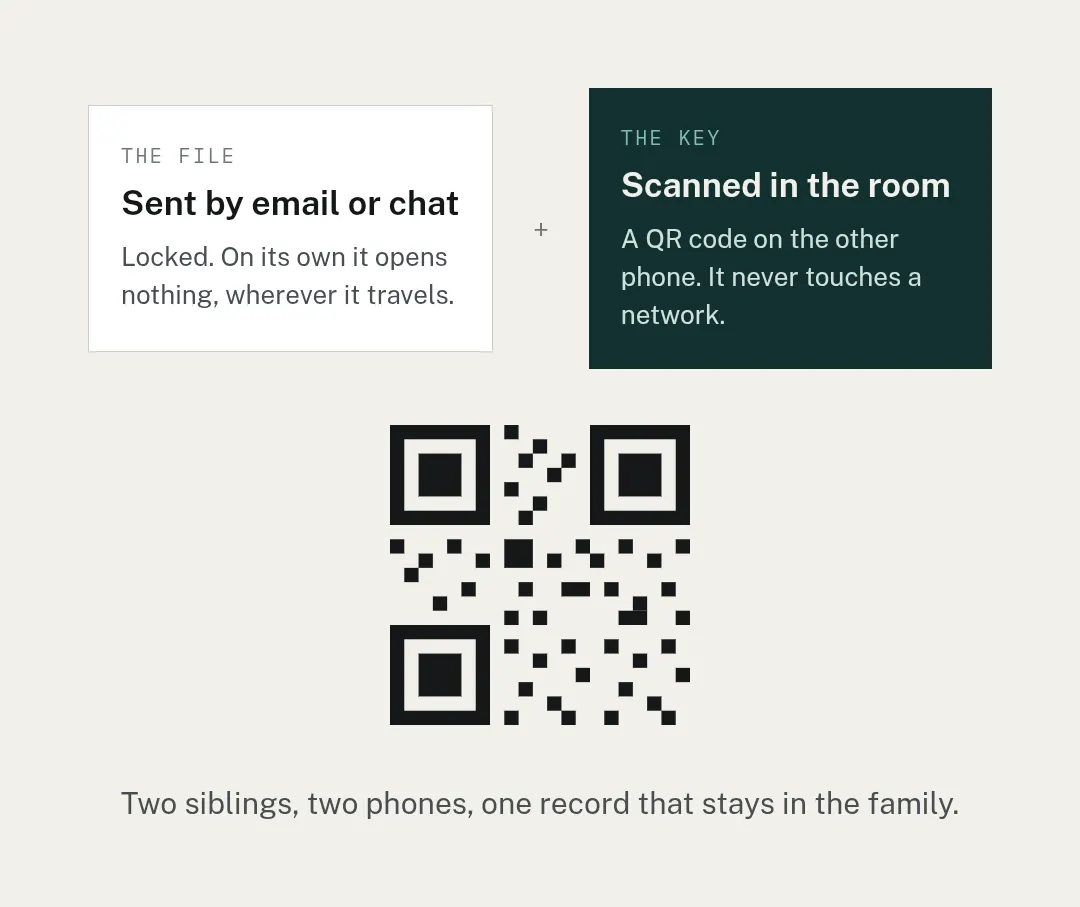
Chart is a record-keeping tool, not a medical device. It holds a household's own documents, keeps the values that were confirmed against them, and prints what is already there. It draws no conclusion from anything it holds, and it is not a substitute for advice from a clinician. All of the above is set out at length in the Chart privacy policy, which is written for the app as designed because the app is still being built.
What it does, and what it refuses to do.
An app asking to hold your family's medical documents owes you plain answers about where they go, who else can open them, and what it will never claim to know.
Is there an account to make?
No — and there is no way to make one. No email, no password, no verification, no "continue with". You open the app and start filing. That is not a signup step we have deferred to later; there is no server for an account to exist on, so the concept does not appear anywhere in the product.
Where does my family's medical record actually live?
On the phone, and nowhere else. Documents, the values confirmed against them, consultation recordings, medications and appointments are all stored on the device. SumaFlow operates no server that could receive them, so there is no copy of your household anywhere but in your own hands.
The app reads my documents with AI. Does that mean they get uploaded?
No. The reading happens on the device. A document is never sent away to be processed, summarised or transcribed, which is the only version of that promise worth making about a medical file. It also means the app keeps working with the phone in airplane mode.
Does it tell me what my results mean?
No, and it is built so that it cannot. Chart is a record: it carries the documents you already have, keeps the values you confirmed against them, and prints them back out. It draws no conclusion from anything it holds — no ranges, no bands, no targets, no figure that changes colour according to what it says, and no reminder triggered by a number. What a result means is a conversation with a clinician, and the Visit Brief exists to make that conversation shorter, not to replace it.
Why does every value have to be confirmed?
Because a record you cannot trust is worse than no record. When the app reads a document it proposes what it found and files none of it — each candidate arrives with the crop of the page it came from directly above the parsed value, at a size you can read without pinching, and you accept it, correct it, or skip it. A value that was read but not confirmed is not in the record. There is no half-saved state to tidy up later.
How does someone else in the family get the record?
Two things have to meet, and only one of them travels. The household file can be sent by email or chat and on its own it opens nothing, wherever it ends up. The key is twenty-four words, read from the other phone in the room — it never touches a network, and it never reaches us. That is what makes it possible to share a parent's record with a sibling in another country without either of you handing it to a company.
What if I lose the 24-word key?
Then that household cannot be opened again, and we cannot open it for you. There is no cloud copy, no recovery email and no key escrow — which is the direct and unavoidable cost of us holding nothing. The app prints a Recovery Kit for exactly this reason. Keep it where you keep the passports.
It records consultations. Where does the audio go?
Nowhere. The recording is made and read on the phone, is never uploaded and is never sent out for transcription. Afterwards each instruction the app picked up arrives as its own card, with the moment it was said available to replay and the currently recorded dose stated underneath, so you can see what accepting would replace. Recording a consultation is something to agree with the clinician in the room first — rules on that differ by country, and the app cannot make that call for you.
What happens if I stop paying?
You keep everything. The record stays on the phone in full, and reading, printing and exporting keep working — a subscription pays for reading new documents for you, and it has never held your history hostage. You can export the whole household to open formats at any time: documents as PDFs, values as a spreadsheet.
Can I get everything out if I want to leave?
Yes, and that is not a paid feature. Export the household to open files whenever you like, and print or share any single sheet on its own. Once a file is in your email or your cloud drive it is governed by that service rather than by the app, which is why sharing is always a deliberate act with the contents shown to you first.
When can I install it, and what will it cost?
Not yet, and we are not going to guess at a date on a marketing page. Chart is designed — the system, the screens, the Visit Brief, the icon — and it is in build. It is not on Google Play and there is no beta to join. Pricing is not set, beyond one decision that already is: cancelling will never remove anything you have filed.
Is SumaFlow Chart a medical device?
No. It is a record-keeping tool for a household's own documents. It does not form a view about anyone's health and is not a substitute for advice from a clinician. Everything shown on this site — the names, values and dates — is illustrative.